Guides
The URLs a store asks for, explained
Written for the moment you actually need them: a rejection notice open in another tab, or a submission form with an empty field. Each one links the official documentation, because that is what decides.
- Guides
- 30 guides
- Videos
- 25 with a short video
- Last checked
- Last checked against store docs 17 October 2026
Start here
-
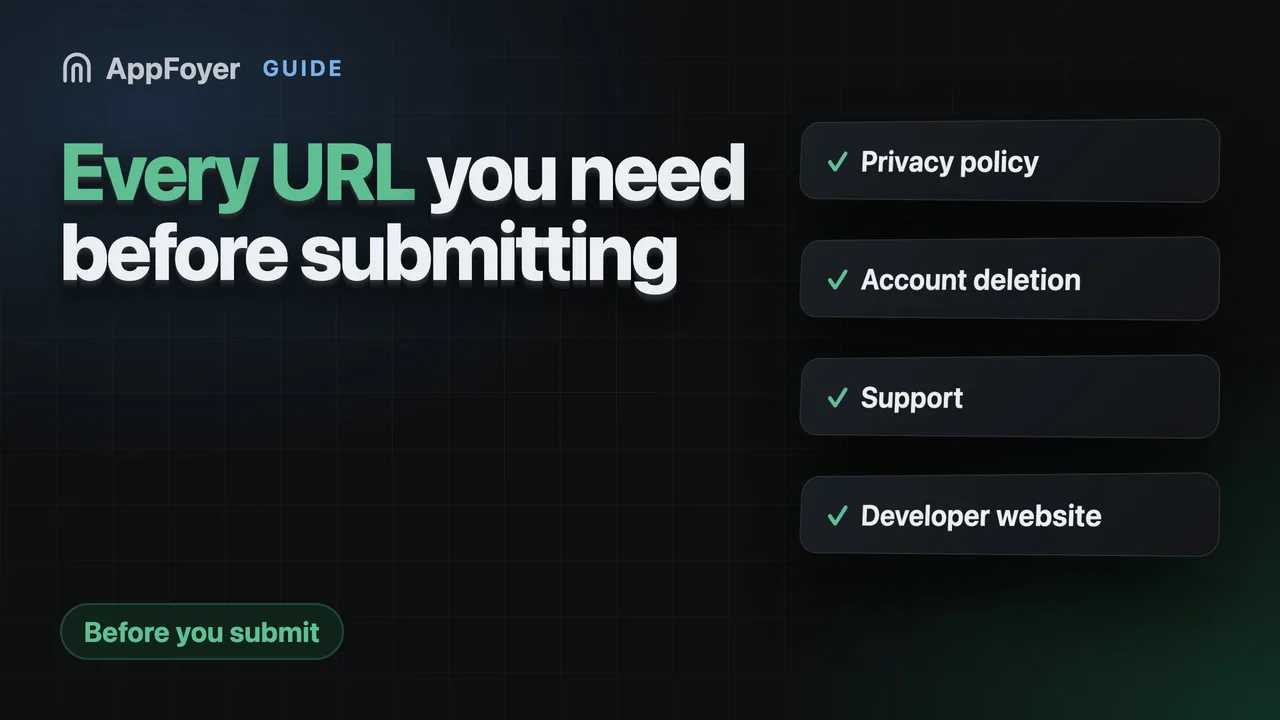 1:09 Every URL you need before submitting an app The full list across Play Console, App Store Connect and AdMob, which ones are required rather than optional, what each page has to contain, and the order to do them in. Read the guide
-
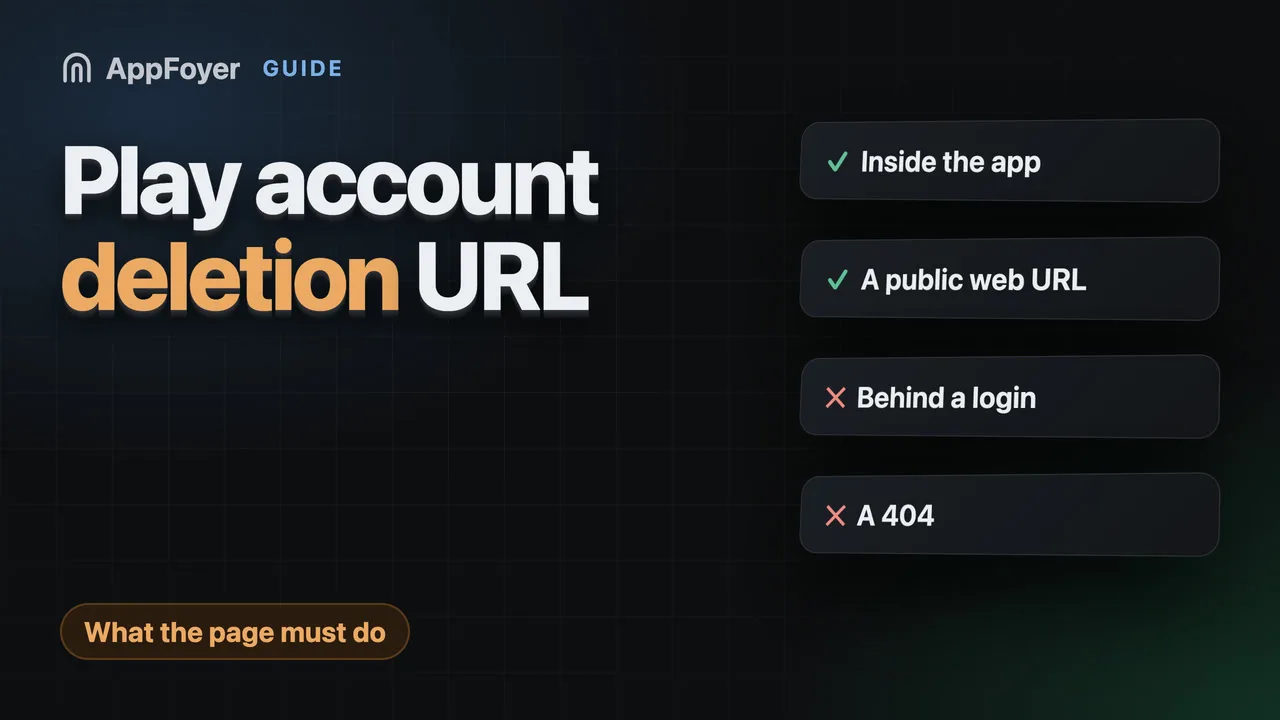 1:21 The account deletion URL Google Play asks for Play Console asks for a public web URL under App content → Data deletion. What that page has to let a user do without signing in, and the mistakes that get a submission sent back. Read the guide
-
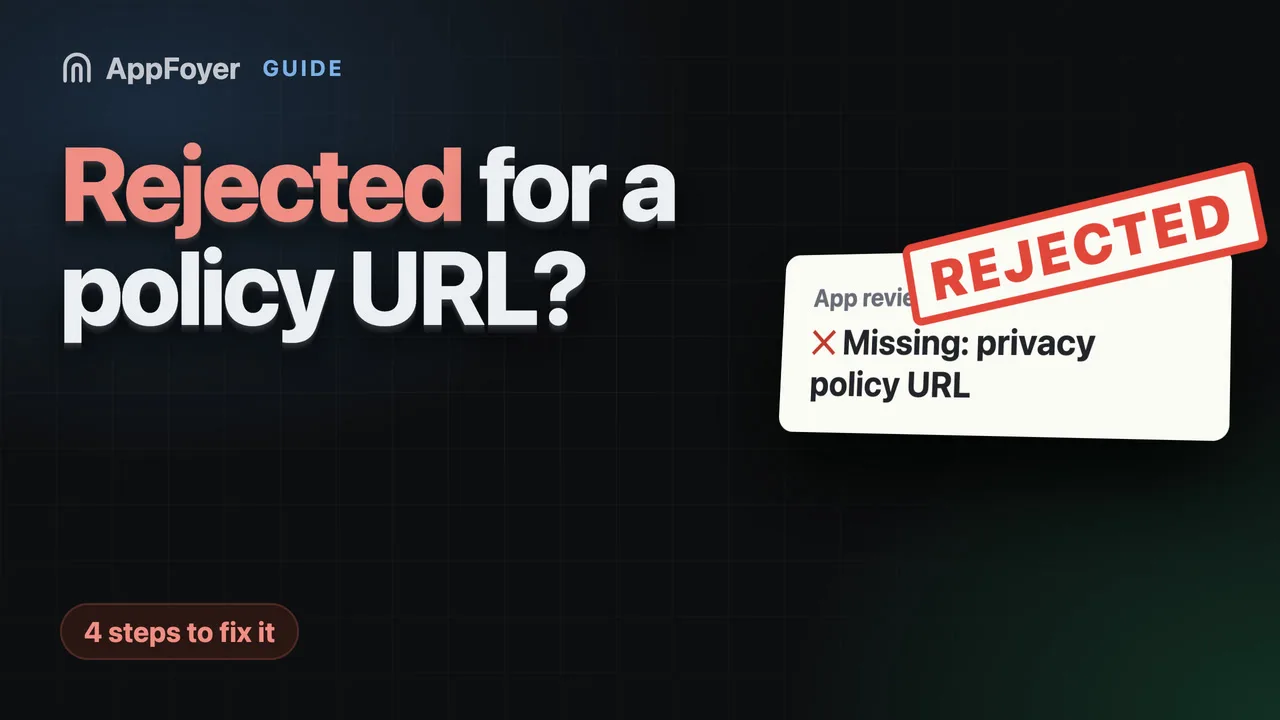 1:20 Your app was rejected for a missing or broken policy URL What to do in the next hour: work out which URL is at fault, get a working one live, update the listing, and resubmit without making it worse. Read the guide
01 · 4 guides
Before you submit
What the stores ask for, whether you need a website at all, and what to do when a review comes back rejected.
-
Your app was rejected for a missing or broken policy URL
What to do in the next hour: work out which URL is at fault, get a working one live, update the listing, and resubmit without making it worse.
Checked Video 1:20
-
Every URL you need before submitting an app
The full list across Play Console, App Store Connect and AdMob, which ones are required rather than optional, what each page has to contain, and the order to do them in.
Checked Video 1:09
-
Does your app need a website?
No store has a field demanding a marketing site — but four separate requirements all resolve to a URL. What you actually need, and what you can skip.
Checked Video 1:04
-
Using a coding agent to write your compliance pages
The facts these pages need are already in your repository. What an agent can genuinely derive, what it must ask you, and the boundaries worth insisting on before you let one near this.
Checked Video 1:10
02 · 6 guides
Privacy policy
Where the policy lives, what it has to say, and why an app that "collects nothing" usually still needs one.
-
The privacy policy URL an Android app needs
Where the URL goes, what the policy has to cover, and the SDK trap that catches developers who are sure their app collects nothing.
Checked Video 1:03
-
Where to host a privacy policy when you have no domain
Six places developers actually put the URL, what each one costs you at review time and two years later, and the one requirement that rules half of them out.
Checked Video 1:07
-
Generator, hosted page, or a lawyer: which one you actually need
Three categories of answer to 'I need a privacy policy', what each one hands you, which part of the problem each leaves behind, and how to tell which one your situation is.
Checked Video 1:16
-
Do I need a privacy policy if my app collects nothing?
Almost certainly yes — and the reason is usually that the app collects more than its developer thinks. How to find out in ten minutes, and what the policy says when the answer really is nothing.
Checked Video 1:19
-
Sending your users' data to an AI API — what Google Play requires
Adding an LLM call to an app is a data-sharing decision, and Play's User Data policy says so explicitly. What has to be disclosed, where, and what the in-app disclosure has to look like.
Checked Video 1:18
-
Writing your app's privacy policy with an AI assistant — a prompt that works
Why "write me a privacy policy" gives you generic text, what a prompt has to make the assistant do instead, and a ready prompt you can copy into Claude, ChatGPT, Cursor or any coding agent.
Checked Video 1:09
03 · 4 guides
Store forms and SDKs
Google Play's Data safety form, Apple's App Privacy details, and the SDK data that decides both.
-
When your Data safety form and your privacy policy disagree
Two declarations about the same app, read side by side, and usually written months apart. What each one is, where they drift, and how to reconcile them from the dependency list.
Checked Video 1:04
-
How to find out what your SDKs collect
A repeatable method, a worked example with Firebase's own published tables, and where to look for the vendors that do not publish one.
Checked Video 1:25
-
How to fill in Google Play's Data safety form and Apple's App Privacy details
What each questionnaire asks, how your SDKs change the answers, the three questions people get wrong, and where each vendor publishes the answers you need.
Checked
-
Fill in Google Play Data safety and App Privacy with the AppFoyer side panel
Install the free AppFoyer Chrome extension, let it follow the console page you are on, connect your account for your own answers beside each question, and import Data safety answers as a CSV.
Checked
04 · 3 guides
Account deletion
The URL each store requires, what the page must let a user do, and what happens after a request arrives.
-
The account deletion URL Google Play asks for
Play Console asks for a public web URL under App content → Data deletion. What that page has to let a user do without signing in, and the mistakes that get a submission sent back.
Checked Video 1:21
-
Guideline 5.1.1(v): Apple's account deletion requirement, and how it differs from Google's
Apple's account deletion requirement, guideline 5.1.1(v): deletion must start inside the app, and deactivating is not enough. What Apple asks that Google does not, and one page for both stores.
Checked Video 1:19
-
A deletion request just arrived. What now?
The part after the page: where requests should land, what you owe the person and by when, what you may keep, and the record that proves you did it.
Checked Video 1:24
05 · 5 guides
Terms, support and listing
Support URLs, terms of service, Apple's EULA, subscription disclosures and the contact details on your listing.
-
The support URL App Store Connect asks for
What belongs on a support page, why a link to your homepage is not enough, and how it differs from the marketing URL.
Checked Video 0:57
-
Does your app need a terms of service?
What each store actually requires, why 'required' and 'a good idea' are different answers, and the five sections that do real work in an app's terms.
Checked Video 1:22
-
The Terms of Use (EULA) Apple asks subscription apps for
Guideline 3.1.2 in practice: where the standard EULA link goes, where a custom one goes instead, and the five things that have to be visible inside the app.
Checked Video 1:15
-
What a subscription paywall has to say
The facts both stores require before purchase, the links Apple wants on the paywall itself, and why these rejections are almost always about placement rather than wording.
Checked Video 1:21
-
The contact details Google Play puts on your listing
Which of the email, phone and website fields you must fill in, what happens to the address you enter, and why the optional website field is the one that matters most.
Checked Video 1:01
06 · 4 guides
app-ads.txt
What the file is, where it has to sit, and why an ad network can report it missing.
-
Why AdMob says your app-ads.txt was not found
How ad-network crawlers find the file, the six things that usually stop them, and how to tell a real problem from a crawl that has not run yet.
Checked Video 1:09
-
What app-ads.txt is, and where it has to live
The file in one paragraph, the line format field by field, the one rule about where it goes that decides whether any of it works, and what to do without a website.
Checked Video 1:22
-
Hosting app-ads.txt when you have no website
What the crawler actually needs, three ways to give it a host without building a site, the redirect traps on each, and how to confirm it works.
Checked
-
app-ads.txt for an iOS app: the App Store field AdMob reads
Which App Store Connect field the crawler follows, why the Support URL is not it, and how to read AdMob's status for an iOS app.
Checked
07 · 4 guides
After launch
Changing a URL in a live listing, publishing to other Android stores, and keeping many apps in order.
-
Changing a URL that is already in a live store listing
Moving a privacy policy or deletion page after the app is published, in the order that never leaves a dead link, and why the old address should keep answering.
Checked Video 1:11
-
Publishing beyond Google Play: the other Android stores
Huawei, Amazon and Samsung each want a privacy policy URL in their own console with their own form. What is the same everywhere, what is not, and what we have not verified.
Checked Video 1:09
-
Keeping compliance straight across ten apps
What genuinely has to be per-app, what can be shared, the two mistakes portfolios make, and the register that turns a yearly panic into an afternoon.
Checked Video 1:23
-
Keeping your privacy policy in sync with your build
A privacy policy is written once and goes stale the day a pull request adds an SDK. How to notice it on the pull request itself, with a free check that reads only your build files.
Checked
Rather have the pages than the reading?
AppFoyer hosts the privacy policy, terms, support and account-deletion pages these guides describe, on their own subdomain, with no domain or server of your own. One app is free.
None of this is legal advice, and store policies change — each guide carries the date its claims were last checked. If a guide and the store's own documentation disagree, the store is right.